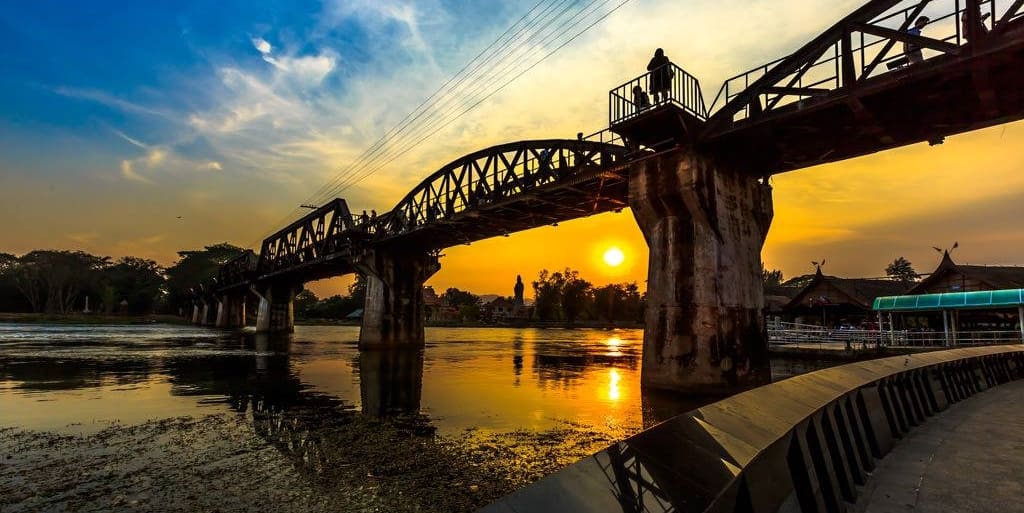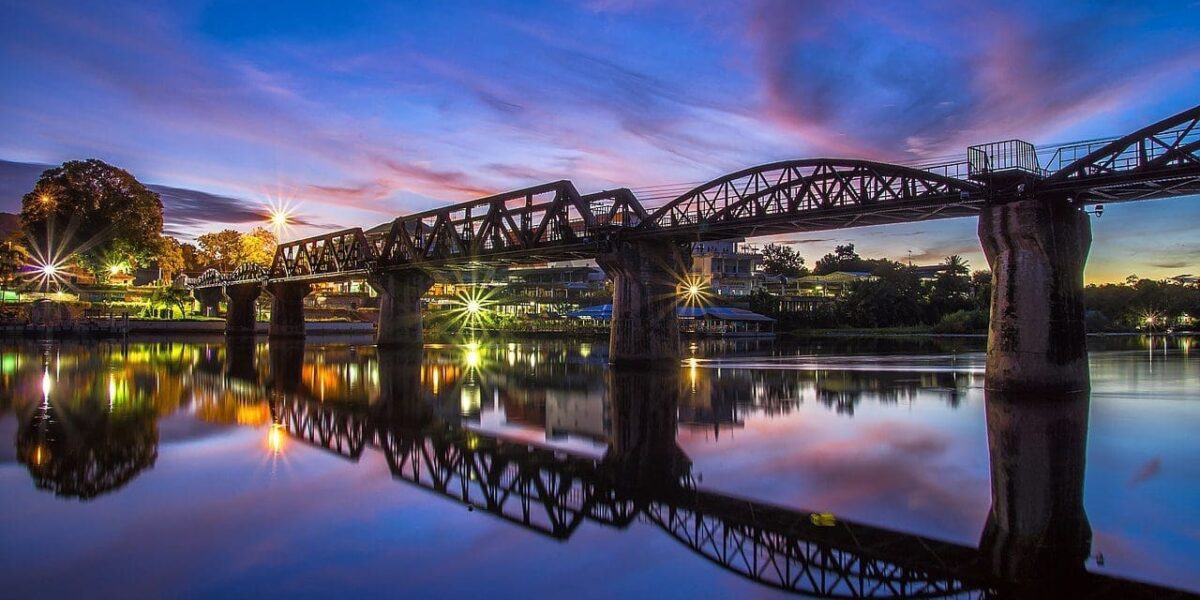
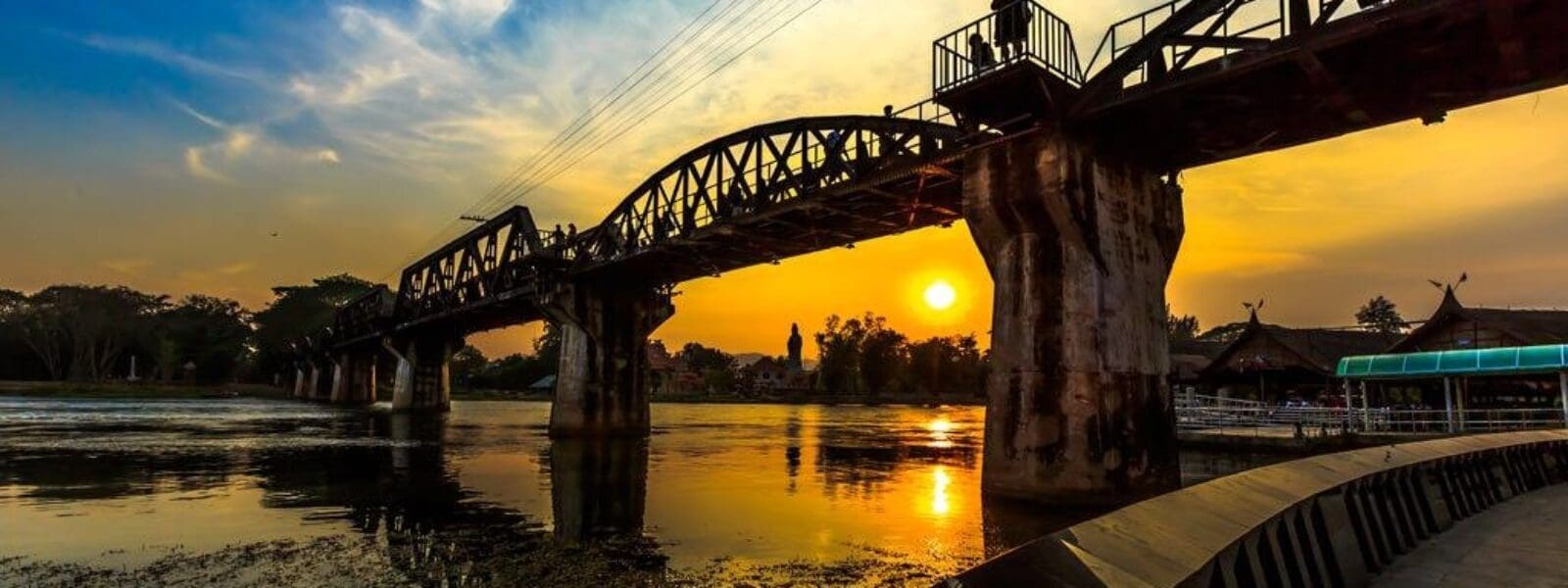
There is a moment, just before you step onto it, when the noise falls away. The steel is warm under the Thai sun, the brown water slides past below, and somewhere down the line a train sounds its horn. Some places are famous. A few are unforgettable. The Bridge over the River Kwai in Kanchanaburi belongs firmly to the second group — black steel and curved trusses carrying not only a railway line, but the memory of everyone who built it.
A bridge built at a terrible price
Between 1942 and 1943, Japanese forces drove the construction of the 415-kilometre Thailand–Burma Railway through jungle, monsoon and solid rock. History remembers it by a shorter name: the Death Railway. Around 60,000 Allied prisoners of war and more than 200,000 Asian labourers were forced into the work. Tens of thousands never came home.
The crossing at Tha Ma Kham was the centrepiece of the line. Prisoners arrived here in October 1942 and first built a wooden bridge; by May 1943 the steel bridge beside it was finished, its spans shipped in from Java and assembled by men working with hand tools and almost nothing else. Allied bombing raids tore out its central spans towards the end of the war, and the bridge was repaired after 1945. Look closely today and the whole story is written into the metalwork — two straight-edged sections in the middle, replacements from the post-war years, with the original curved trusses still standing on either side. Eighty years on, the trains still cross it. So can you.
Fact, fiction and a whistled march
Pierre Boulle’s 1952 novel and David Lean’s Oscar-winning 1957 film The Bridge on the River Kwai made the name world-famous — and largely fictional. The film was shot in Sri Lanka, not Thailand. No commando raid ever blew the bridge up. Even the name has a touch of theatre: until the 1960s this stretch of water was considered part of the Mae Klong, before it was renamed Khwae Yai — the river the whole world already knew as the Kwai.
The true story is quieter, and it waits just down the road. At the Thailand–Burma Railway Centre, an interactive museum and research centre, the railway is told through maps, objects and the voices of the men who survived it. A few minutes away at Don Rak War Cemetery, 6,982 Allied prisoners of war lie in rows beneath the frangipani trees, each stone carrying a name, an age and a date. Most of them were very young.
See it the way it deserves to be seen
Arrive at golden hour, when the light turns the steel copper and the river runs gold, and the bridge becomes something you feel rather than photograph. Walk out onto the wooden boards between the rails. Stop at one of the refuge platforms, rest a hand on the iron, and listen to the water. It moves exactly as it did in 1943.
Our RV River Kwai itineraries bring you here as part of a far greater journey — the raw rock cutting of Hellfire Pass, ancient Khmer ruins, waterfalls hidden deep in the hills, riverside temples at dawn — all in colonial-style comfort aboard Thailand’s first five-star inland cruiser. The history is unforgettable. The way you experience it should be, too.
Good to know
- Trains still cross the bridge; step onto one of the side platforms when a train approaches and follow your guide’s instructions.
- Around midday it can be very hot on the steel – a hat and water are recommended.
- Every year in late November and early December, the River Kwai Bridge Week brings a light-and-sound show that commemorates the history of the railway.
On these cruises
You visit the Bridge over the River Kwai on the following RV River Kwai cruises:
- 7D/6N River Kwai Heritage Cruise – Day 7 (Sunday)
- 4D/3N River Kwai Cruise (upstream) – Day 4 (Thursday)
- 4D/3N River Kwai Cruise (downstream) – Day 4 (Sunday)
- 4D/3N River Kwai Golf Cruise (upstream) – Day 4 (Thursday)
- 4D/3N River Kwai Golf Cruise (downstream) – Day 4 (Sunday)
- 7D/6N River Kwai Golf Cruise – Day 7 (Sunday)
Compare all River Kwai cruises
Also along the way
Kanchanaburi War Cemetery & Railway Centre · JEATH War Museum · Wat Tham Khaopoon · Hellfire Pass